How Artificial Intelligence Integration Changes How Developers Create Immersive Experiences

Video game developers are beginning to shift toward game worlds that live and adapt organically rather than being entirely pre-scripted. For years, gamers played through games with fixed spawn points, so every enemy encounter was fixed. It’s sure that a designer manually placed any chest loot that’s found in these virtual worlds. That ideal is quickly becoming passé.
By implementing AI into games, developers are changing their approach to game design. Player interactions now prompt immediate responses from game systems. These systems understand player behavior to dynamically adjust pacing and difficulty, while also modifying story progression to maintain player immersion. These advancements extend beyond basic graphical improvements or reduced loading durations.
The Mechanics of Personalized Play and Adaptive Loops
The most obvious result of these developments has been the implementation of Dynamic Difficulty Adjustment (DDA). Slot game algorithms evaluate engagement by measuring playtime, reaction time, failure rates, and excitement levels.
The game adjusts its difficulty by simplifying mechanics when players struggle or by adding complexity when players master content quickly. The system aims to maintain players’ engagement through continuous flow. Building this behavior pattern into player psychology makes them believe the game suits their style.
The experience of playing online slots offer entertainment and profit, and most veteran players develop through personalized difficulty adjustments and reward systems. AI systems enable developers to process thousands of user inputs per minute while delivering personalized gameplay now. It’s maintaining the right balance of danger and reward per mental state.
90% of gaming industry developers surveyed in 2025 said they’re testing or they’ve implemented AI. This tech adaptively modifies gameplay to increase user retention.
Infinite Variety Through Procedural Generation
AI development has expanded rapidly into procedural generation. Traditional game developers had to dedicate thousands of hours to building detailed virtual environments through manual world-building. As a result, most games feature only a couple of areas.
However, with generative AI, creators can input a “seed” for the technology to generate an entire world from scratch. Whether that be lush ecosystems, dungeons, or sprawling cityscapes, players will never see the same configuration twice. This makes games significantly more replayable.
But that’s not all, because generative AI has improved development productivity by as much as 30%. It’s now putting AAA tools into the hands of smaller teams. Gamers will soon never see the same asset twice, as worlds change based on progression.
Intelligent Audio and Visual Upscaling Technologies
Visuals and sound don’t just appeal to one sense; immersion is multi-factorial. Artificial intelligence is also assisting developers with game aesthetics, without requiring gamers to purchase hyper-spec computers and consoles.
Games achieve high 4K visual quality through deep learning super-sampling, while AI upscaling retains image clarity in real time. AI technology is transforming game audio production alongside advances in graphics. Dynamic music engines are no longer limited to playing a single continuous track in the background.
Using AI, soundtracks can be created on the fly that intelligently adapt to the build-up of suspense in a game. The audio track quietly slows and lowers volume as a player moves through shadowy environments. As soon as an enemy startles the player, the game music immediately switches to a faster tempo.
Smarter Non-Player Characters and Responsive Narratives
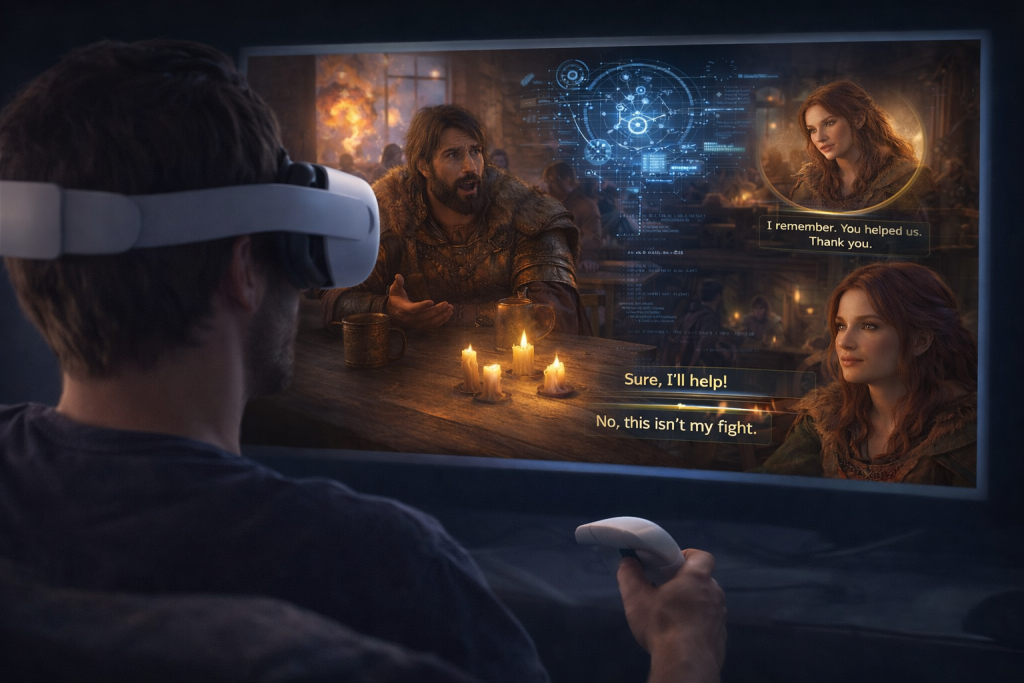
Living inside game worlds are Non-Player Characters (NPCs). Over the years, talking to them felt stiff, stuck in awkward loops or odd movements through space. Now, their words flow better because they draw from natural language systems that understand how people really speak. These digital beings respond in ways that feel real, shifting tone and thought as someone across a table might.
This game feature allows NPCs to hold meaningful discussions by tracking each interaction. This lets players feel genuine free will as they watch NPCs react socially to their decisions.
The worldwide AI in gaming market size is expected to reach around $38 billion by 2034, as demand for hyper-realistic interactions takes center stage. When an NPC displays unexpected shock at an explosion or recalls a past favor after a 10-hour gap, players experience an emotional bond beyond scripted interactions.
The New Era of Living Games
Games are ecosystems, not products. Period. Games, as they’re artificial experiences, are evolving to the point where developers rely on AI management. They don’t laboriously handcraft every part of the system themselves.
AI will free designers to focus on the broader experience by offloading real-time game balancing. It’s possible because systems are now smart enough to handle these tasks, whether a game specializes in creating dynamic worlds. They’ll understand emotions, respond to them, or generate challenge curves that adapt to player performance.
Game developers will be able to build interactive worlds that dynamically respond to player behavior using learning technologies. The industry will reach a point where there’s no actual distinction between developer and AI content. AI will pump out responses to players that will look human.